

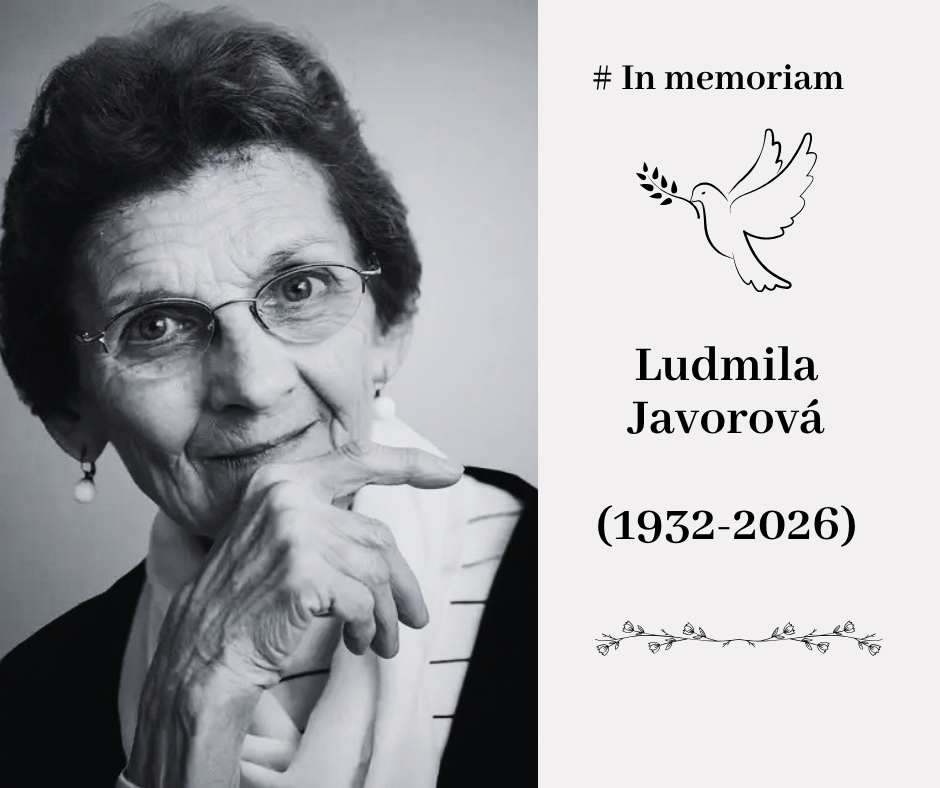
It was with deep sorrow that we learned of the death of Ludmila Javorová — a theologian, religious educator, and one of the most significant figures of the Czechoslovak underground Church. She died on 17 September 2026 in Rajhrad near Brno, at the age of 94.
Ludmila Javorová grew up in a Catholic family in Brno. Under the communist regime, when religious life for women had been made virtually impossible, she became involved in Koinótés, a clandestine Catholic community. From 1964 onwards, she was among the closest collaborators of the underground bishop Felix Maria Davídek. She helped to organise the structures of the clandestine Church, assumed responsibilities corresponding to those of a vicar general, and on 28 December 1970 was secretly ordained to the diaconate and the priesthood by Davídek. One reason behind this decision was the need to provide spiritual care to women imprisoned by the regime, including religious sisters whom male priests were unable to reach. She was the only one of the women ordained as a priest at that time who later chose to tell her story publicly.
Her ordination became a matter of dispute within the underground Church itself and, after the fall of communism, was not recognised by the Roman Catholic Church. Ludmila Javorová complied with the prohibition against exercising priestly ministry, yet she never renounced her conviction that she had received an authentic calling. She remained within the Church, worked as a religious educator, participated in the life of her parish and the Diocese of Brno, and continued to speak about the place of women in Christianity. She reminded the Church that women’s gifts are gifts from God and should not be left unused.
Her life cannot be reduced solely to the debate over the validity of her ordination. It bears witness to courage, responsibility, and faithfulness to one’s conscience — even when such faithfulness meant living in secrecy and enduring silence, misunderstanding, and rejection. Ludmila Javorová served her community under persecution, taking on the responsibilities demanded by dramatic circumstances and by the needs of other women. Later, by choosing to speak about her experience, she helped restore to the history of the Church the memory of women whose ministry had remained invisible for far too long.
We bid her farewell with gratitude for her witness, her courage, and her theological hope. Her story remains a powerful call to listen to women’s voices, to recognise their vocations, and to create spaces within the Churches where all the gifts entrusted to them may be fully placed at the service of the community.
May she rest in peace.
Photo: private archive of Tomasz Maćkowiak / Znak